
Hello and welcome back to the Chamois Mountaineering Club blog, this article will be the start of several where we look at some of the many reasons that anyone wanting to walk or mountaineer in the UK and especially North Wales should consider joining the club. To begin with I thought it would be nice to have an article by an active member of the club who had a fantastic trip to the Julian Alps in Europe and has written a very informative article. Before looking at the article I would like briefly to introduce the club.
The Chamois Mountaineering Club is a national club that has been running since 1964 and has members from across all regions of the UK. We are very friendly and welcoming to new members and our members partake in a wide range of activities including hill walking, long distance walking, summer and winter mountaineering, rock climbing, ice climbing, bouldering, mountain biking and paddle boarding. To be fair if there is an activity that happens in the outdoors there is a high chance that we are doing it at some point in the year. We run 2 meets a month all throughout each year and have several social get together meets each year. One meet each month is always held at our fantastic club hut: The Chamois Mountaineering Centre which has over 50 beds of which 8 area always reserved for the use of members. The other meet is held somewhere in the UK in areas such as the Lake District, Scotland and the Peak District.
We are always keen for new members and so if you think you might like to join the club why not get in touch and come along and join us at a meet to see if you like us? You can contact the membership secretary easily via the site or simply send an email to memship@chamois.org.uk
Okay enough about the club and onto the Julian Alps!
Summer in the Julian Alps
The Chamois have made several trips to Europe over the Summer period in recent years, in addition to the regular skiing and the climbing meet to Calpe in Spain. In June 2017, the club had an exciting time in the Ordessa National Park, in the Spanish Pyrenees. In 2018, we went to Vallouise in the Écrins National Park in France. In 2019, the location of choice was the Zillertal Alps in Austria, with the Chamois members based in Mayrhofen. Where next? To answer this question, I thought about other alpine locations. As I had never been to Slovenia, I decided to take a solo trip to see what the mountains were like. Therefore, in the Summer of 2020, I booked a 10-day TUI trip to Kranjska Gora, based at the Kompas Hotel. The pandemic put paid to my plans for July 2020, which slipped to July 2021, which then slipped to 2022 and changed from a solo reconnaissance mission to a week-long holiday with Judi in the hills.
 Kranjska Gora lies adjacent to the Triglav National Park, which gets its name from Slovenia’s highest peak “Triglav” (2864m). The ascent of Triglav is a pilgrimage for many Slovenians, who are expected or encouraged to climb it once in their lifetime. Allegedly, those that reach the summit are lashed by their colleagues using a rope to celebrate their achievement. The number of lashes received accords to their age. Clearly, it pays to summit Triglav when one is as young as possible. Our 7-day holiday in Kranjska Gora proved to be better than expected and enabled me to gather some useful information. At 810m, the town is a busy ski resort in the winter and in 2023, in Planica, the next valley along from Kranjska Gora, they are hosting the world ski-jumping championship as well as one of the Nordic ski championship events. The Triglav National Park embraces the Julian Alps which provides unrivalled opportunities in the Summer for all aspects of mountaineering. The 1:3000 tourist map, available locally, shows details of 21 different walking trails of various degrees of difficulty, this is without venturing into the high mountains. The tourist map also shows 17 bike routes, which excludes all the road bike opportunities over the mountain passes. The dry continental climate favours mountaineering activities between June and September. As Kranjska Gora is a ski resort, there are loads of accommodation opportunities available including hotels, apartments, and camping. Personally, I would not choose camping, as during our six night stay we had a thunderstorm every night. The walking routes can be easy or strenuous, depending on capability or fitness. As far as mountain biking is concerned, there are at least 5 bike rental shops in the town, all providing a good selection of MTBs and e-MTBs. A hard-tail e-MTB will set you back around Euro 40/day. There is even a 7-day, hut-to-hut, MTB route around the Julian Alps, averaging around 40km/day with up to 1600m climbing/day. There are some easy mountaineering routes, but others can be much more challenging. On these, everyone is expected to carry a helmet, as there is a considerable amount of lose limestone about in places. All should carry Via Ferrata kit and be able to use it.
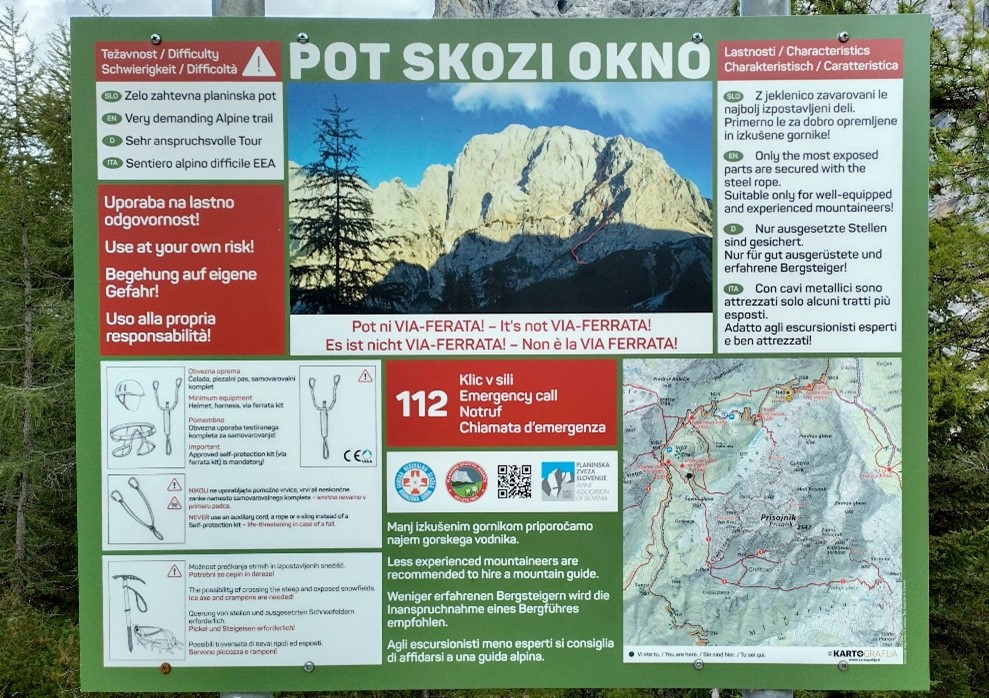 Routes are protected but often only in the most exposed situations. The good news is that there are many mountain huts which provide good food at a reasonable cost, for day-trippers and accommodation in those huts positioned to serve the longer routes and more remote peaks. The walking, cycling and mountaineering trails are well marked with yellow, blue or red signs respectively.
The book entitled “Walking the Julian Alps of Slovenia” by Roy Clark and Justi Carey provides a good guide to mountaineering in the whole of the Julian Alps, based on the three main gateways, that is: from Kranjska Gora, Bovec or Lake Bohini. The Freytag & Berndt map (1:3500) WK5141 covers most of the Triglav National Park. Those using it should consider having it laminated to protect it from wear & tear. For those Chamois that have not already been to the Julian Alps, I can confirm that the location is suitable for all, depending on their capabilities, experience, fitness and aspirations.
 Moreover, it is also easy to slip over the border into Italy/Austria depending on the route. Slovenia is cheaper than the adjacent countries of Austria and Italy, which is why it gets busy at weekends, as the weekend warriors from Italy/Austria nip over the border for adventure and good value. Outside weekends and the holiday season in late July/August, the mountains and alpine meadows are relatively uncrowded.
Getting to the Julian Alps is relatively easy; either by using a Tour Operator or a budget airline and local transport or a self-drive car. TUI and Inghams fly to Salzburg and there is an easy 2-3 hr coach trip to Kranjska Gora or Bled. However, you are constrained to use the Tour Operators accommodation. Alternatively, Wizz/Easy Jet fly to Ljubljana from Luton/Gatwick and there is a coach from the City Centre to Kranjska Gora/Bled which costs around 9 Euros.